


Marmotest is a partner of Politecnico di Torino in research addressing quarrying challenges and in the development of engineering theses, involving undergraduate and doctoral students.
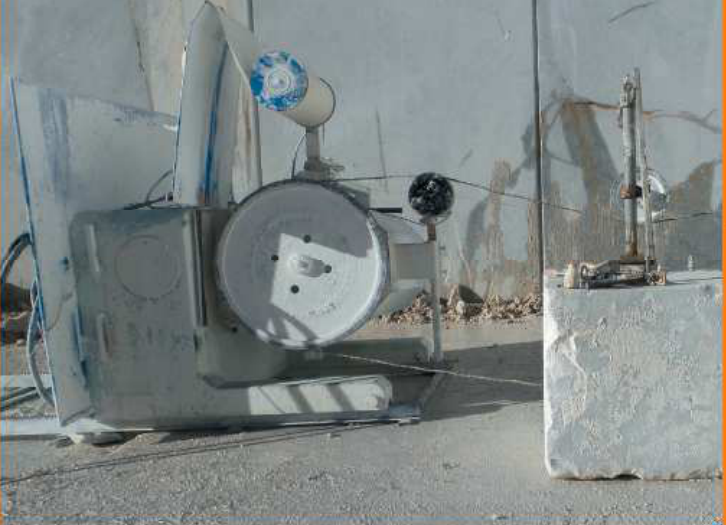
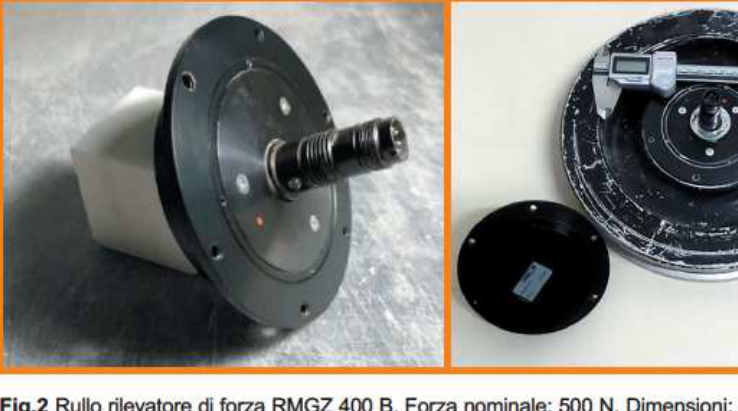
Experimental quarry study of three diamond wire saws equipped with bearing load cells to measure diamond wire tension during cutting. The research analyses machine behaviour in different operating configurations.
Diamond wire saw cutting in the quarry: video supporting the experimental research on diamond wire tension measurement.
Laboratory study of the strength of diamond wire and, above all, the different joints used in quarries. The tests analyse failure and pull-out mechanisms, behaviour at different temperatures, and deterioration of mechanical properties after use.
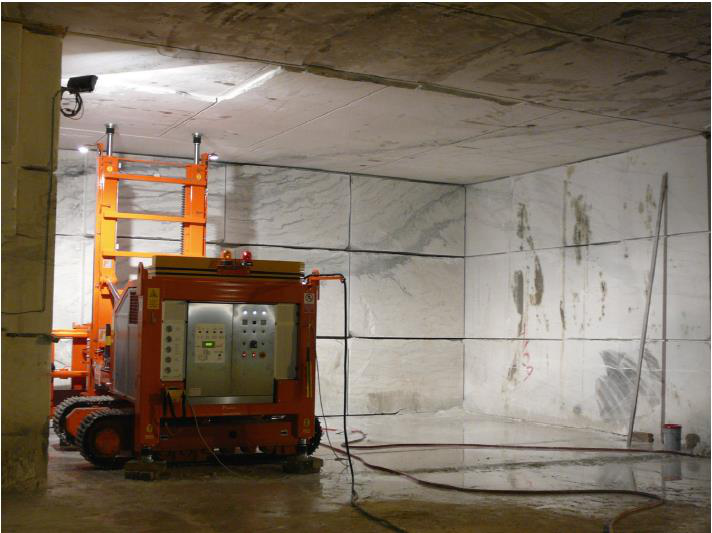
Analysis of cutting difficulties experienced by chain saws at the Penna dei Corvi quarry. The study investigates rock–tool interaction through petrographic analysis, microhardness measurements, CERCHAR abrasivity tests and tool wear assessments.
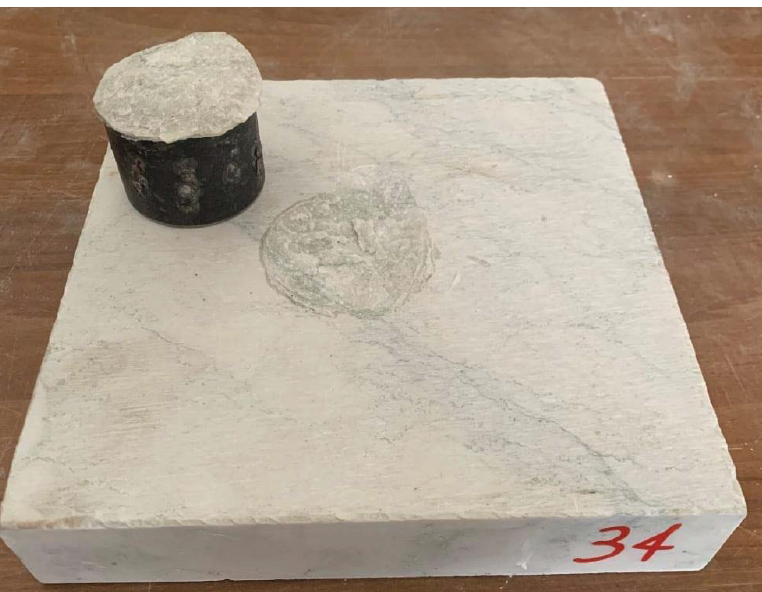
An experimental comparison of different resins using tensile adhesion and shear tests on various stone substrates and surface conditions: from polished to sandblasted, from dry to wet, including substrates kept fully wet for several days. The study aims to identify the most suitable resins for quarry bench reinforcement under different operating conditions.
Example of an ASTM D7617 test report on fibreglass bars with a nominal diameter of 25 mm, used to reinforce quarry benches. The document presents the test apparatus, photographs, results and specimen load–compression graphs. Client references have been removed.
Marmotest collaborates with the University of Turin’s Department of Earth Sciences to study and analyse quarry face stability using aerial photogrammetry with drones. The collaboration combines geostructural and geomechanical surveys with three-dimensional reconstruction of rock masses.
Marmotest provides quarry face surveying and analysis: drone image acquisition, GPS surveying of control points to orient and georeference the three-dimensional model, point cloud and 3D model processing, and investigation of rock mass discontinuities.
Geometric data are combined with geostructural and geomechanical information to identify potential instability mechanisms and carry out stability analyses. Photogrammetric surveys also allow high or difficult-to-access areas of quarry faces to be studied.
Georeferenced 3D quarry model
The article Geostructural and Geomechanical Study of the Piastrone Quarry (Seravezza, Italy) Supported by Photogrammetry to Assess Failure Mode, published in Geosciences in 2020, presents an application of these techniques to a marble quarry in the Apuan Alps. Stefano Bianchini is among the authors, alongside researchers from the University of Turin and Politecnico di Torino.
The study combines drone and ground imagery, GPS-georeferenced point clouds and conventional surveys. Analysis of discontinuity orientation and persistence identifies the main fracture sets and assesses potential sliding and toppling mechanisms. The research also investigates the influence of rock bridges, which can increase strength and improve quarry face stability.
Reference: Bonetto et al., Geosciences, 2020, 10(2), 64. DOI: 10.3390/geosciences10020064.
